Start with the outcome.
Define what marketing is supposed to improve before deciding what to publish, advertise, redesign, or automate.
LogicAide builds marketing strategies that connect audience, positioning, messaging, website experience, search, content, social, email, campaigns, and measurement around a clear commercial objective.

Strategy creates one decision layer across the entire marketing system. It clarifies what the business is trying to accomplish, which customers matter most, what message should lead, and which channels deserve attention.
Define what marketing is supposed to improve before deciding what to publish, advertise, redesign, or automate.
Focus on the customers, decision-makers, problems, and buying situations with the greatest value.
Website, search, social, email, sales materials, and campaigns should reinforce the same core positioning.
A useful strategy makes it easier to decide what to do, what not to do, and what to measure next.
Qualified leads, pipeline, sales support, visibility, retention, launch support, or another clearly defined outcome.
Define success →Identify priority segments, decision-makers, pain points, objections, information needs, and buying context.
Prioritize audience →Clarify the value proposition, differentiation, proof, tone, and message architecture that should lead the market conversation.
Sharpen message →Website, SEO, content, social, email, paid search, partnerships, or campaigns—selected because they support the goal.
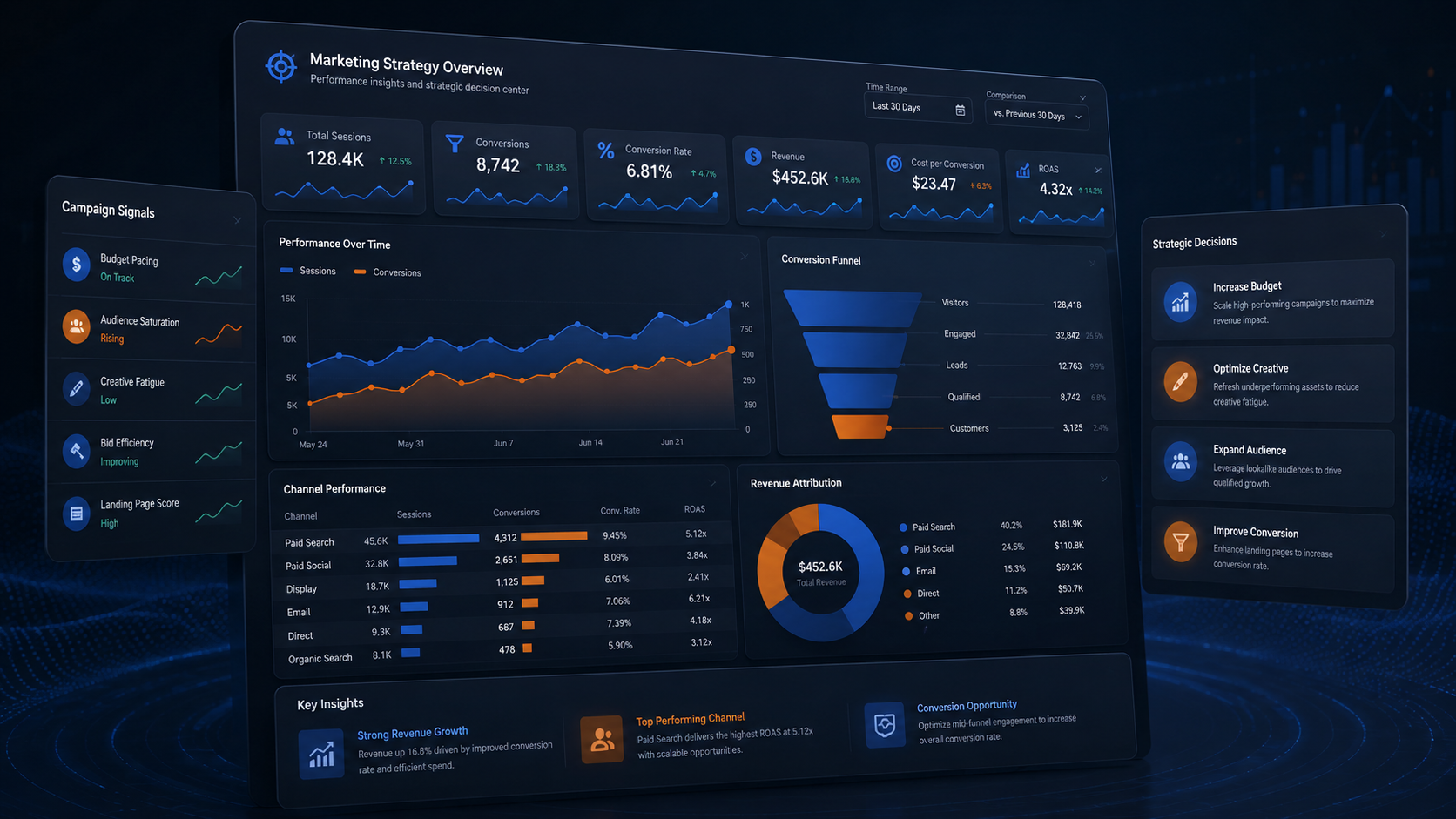
Choose the mix →Define the signals, conversion points, campaign data, and business outcomes that should guide the next decision.
Measure & refine →Each channel should have a clear role in the customer journey. Some create discovery, some build understanding, some establish trust, and some convert or continue the relationship.
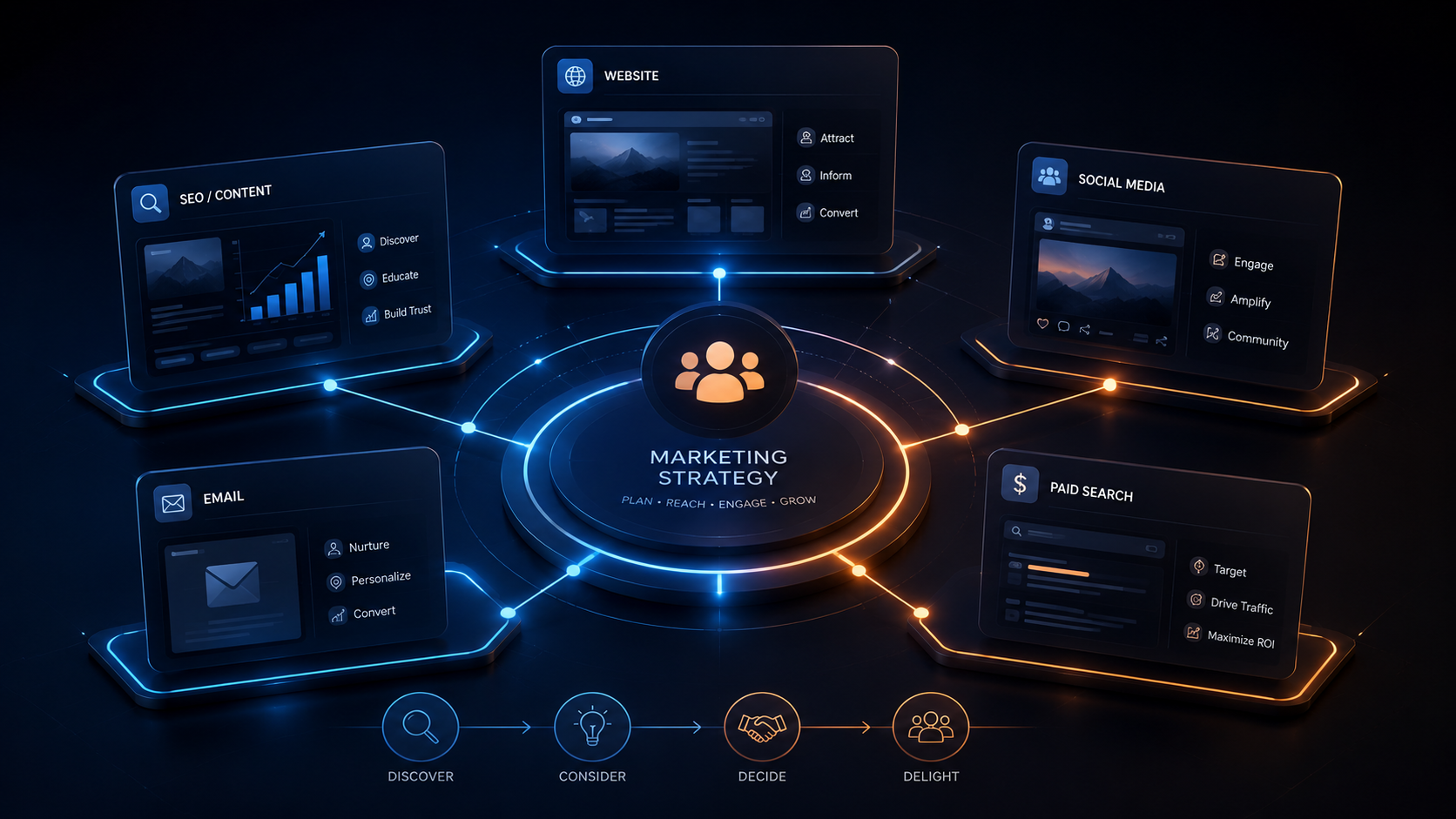
The strategy should account for what prospects need at each stage instead of treating every interaction like a final sales pitch.
Search, social, referrals, campaigns, partnerships, and content.
Positioning, service pages, useful content, and relevant examples.
Brand quality, expertise, process, proof, and consistency.
Forms, calls, landing pages, consultations, and CTAs.
Email, follow-up, useful content, and relationship building.
Measurement should answer practical questions: Which channels attract the right audience? Which pages convert interest? Where are prospects dropping off? Which campaigns deserve more or less investment?
Goals, offer, audience, market position, current assets, analytics, sales process, and constraints.
Decide which audiences, offers, messages, channels, and gaps deserve attention first.
Define the customer journey, content needs, channel roles, website requirements, campaigns, and measurement.
Execute website, content, SEO, social, email, paid search, campaigns, or technical support according to the plan.
Review performance, customer response, conversion behavior, and business outcomes to adjust priorities.
No. A good strategy prioritizes the channels that fit the audience, buying process, business goals, resources, and economics.
Yes. Paid search can be useful when search intent, competition, economics, and landing-page experience support it. It should remain a tactic within the broader strategy.
Yes. If the current website weakens positioning, conversion, SEO, credibility, or customer flow, website changes may be an important part of the plan.
Yes. The strategy can guide website design, branding, SEO, content, social, email, campaigns, analytics, automation, and related implementation work.
We can help define the strategy before choosing the tactics.